

Why the quotation never matches the site budget
Buyers comparing AC charging pile quotations usually focus on the unit price. The gap that actually hurts a project sits somewhere else: what the quotation silently excludes. Two suppliers can quote the same charger configuration and land far apart, not because one is overpriced, but because one price stops at the cabinet door and the other stops at the transformer.
We see this pattern often in enquiries from overseas purchasers: the buyer holds a equipment-only price, the EPC contractor holds a turnkey figure, and the two do not reconcile. Neither is wrong. They are simply measuring different scopes. To judge whether an ac charging pile supplier is quoting competitively, you first need the cost broken into layers that can be compared line by line.
Four layers that make quotations comparable
A practical approach used across the industry is to quote by delivery boundary. Layers should not overlap and should leave no gaps, so that two suppliers’ numbers can be aligned.
- Equipment: charger body, power modules, cables and connectors, metering and communication units, protection devices supplied with the unit.
- Electrical interface: incoming breaker, cable size and route length, earthing practice, whether a separate distribution cabinet or branch box is required.
- Civil and installation: foundation, conduits, drainage, canopy, lifting and positioning.
- Services: commissioning, communication integration, acceptance documentation, warranty response.
Write these four layers into the enquiry document and suppliers will respond in a common language. Otherwise you receive a single total and cannot tell which item is driving it.
Inside the equipment layer, the connection method sets the cost
Many buyers assume charger pricing scales with rated power. On the distribution side, the cost structure is usually driven by how the chargers connect to the grid. A single charger with its own feeder, several chargers sharing one low-voltage outgoing circuit, or a central distribution point feeding all bays — these three arrangements differ sharply in switchgear, cable quantity and site labour.
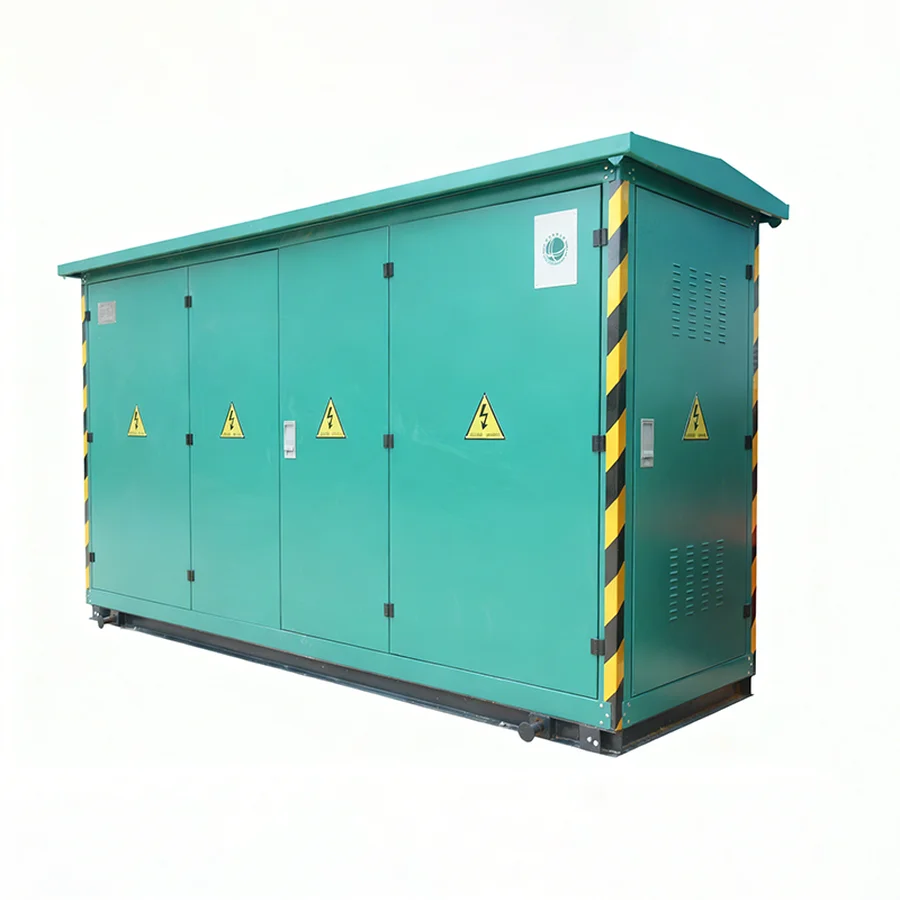
For depot and station projects, a common arrangement is one central distribution point feeding each charging bay radially. The choice at that point then moves the whole budget. Take the industry-standard XGW-12 Box-Type Switching Station: Reliable 10kV Ring Main Unit for Power Distribution as an example: it integrates MV incoming and outgoing circuits, protection and metering inside a transportable enclosure, which suits constrained sites and fast energisation. The trade-off is fabrication and transport cost for the enclosure itself, which runs higher than building a room and installing panels on site.
If the site is generous and an existing electrical room is available, assembling fixed-type panels one by one may work out cheaper. There is no universal answer here, only a match or mismatch with site conditions.
Project record: where the money actually went
A mid-sized depot project we followed last year had these conditions: roughly ten charging bays, a hard-surfaced yard, an incoming supply taken from the low-voltage side of a nearby transformer, and a client who wanted minimal wet trades on site with a two-month window.
The contractor’s first plan was a small electrical room with metal-clad panels. The problem was programme and civil work: masonry, curing, finishing, then panel installation and commissioning inside two months, with no suitable drainage on site. The plan changed to a prefabricated enclosure as the central distribution point, with the MV side and LV outgoing circuits completed inside one enclosure. On site, only the foundation and cable terminations remained.
The outcome was not “cheaper” but “more controllable”. The enclosure cost more per unit than panels in a built room, yet it removed civil works and site coordination from the critical path, and the total account recovered the difference on programme. The lesson: the correct unit of comparison is not equipment price but total spend up to energisation.
Items frequently left out of the budget
- Cable measured as straight-line distance, while actual routing includes bends and slack — the quantity gap is often substantial.
- Earthing grid and equipotential bonding, which add material and labour on high-resistivity soil.
- Communication integration requiring a usable network on site, otherwise commissioning stretches out.
- Responsibility for compiling acceptance documents, which defaults to the buyer if not assigned.
How to review the technical annex of a quotation
Beyond price, there is a quieter cost: a vague technical annex generates variation charges later. Treat the annex as part of the contract when you review it.
- Check the standard edition first. Whether the annex states the year of the edition it references is a direct signal of document discipline. For low-voltage assemblies, for instance, the IEC 61439 series is structured in several parts by function; if an annex still cites an older number generically, ask which edition it is based on.
- Then match the test report. The model, the construction and the standard edition named in the report must correspond to the equipment you are buying. Common practice is to require a third-party test report and to verify yourself that the standard cited is the current edition — do not skip this step.
- Finally, read the boundary description: where the incoming and outgoing interfaces sit, the accessory list supplied with the unit, spares, and warranty response. Put each item in writing.
Where the project also involves MV distribution and protection, it is worth comparing how indoor drawout construction such as the KYN28-12 Metal-Clad Switchgear | 12kV Medium-Voltage Distribution fits into an electrical-room scheme against a prefabricated enclosure, and deciding which suits your site.
Three things that decide long-term cost, not purchase price
Purchase price is paid once. Operation and maintenance run for years. Three questions are worth asking any supplier.
Spare parts availability. Power modules, cable assemblies and control boards are consumables. Whether they can be replenished within a reasonable lead time affects downtime more than the unit price does.
Documentation completeness. Wiring diagrams, protection settings, commissioning records and maintenance manuals should ship with the equipment. Without them, every future service visit starts from scratch.
How changes are handled. Variations are normal during execution; what matters is a clear change process and traceable pricing. This is hardest to judge on a first order, and usually has to be inferred from how carefully a supplier answers technical questions during tendering.
Read a quotation as a technical document, not a price list. The first tells you where the money goes; the second only tells you the total.
So there is no single answer to what AC charging pile supply costs, because it was never a single equipment price — it is a set of delivery boundaries. Define the boundaries, and the numbers become comparable.