
On a tight site, the equipment itself is rarely the problem. The clearances around it are. Maintenance access, cable bending radius, lifting position, ventilation — these get compressed into a single line on the drawing marked “to be coordinated on site,” and then they come back as rework during installation.
So the question of how to choose a compact substation is really about what the site can give you first, and what equipment format follows from that. Reverse the order and you spend the rest of the project patching.
Measure the site before you open a catalogue
Walk the plot and confirm these points. The shortlist narrows fast once they are settled:
- Is the available footprint rectangular or irregular, and do existing buildings, walls or buried services restrict lifting and door swing?
- Which direction do the cables enter and leave, and what cross-section and number of cores set the bending radius and the space beneath the enclosure?
- What do local rules say about walkway width, fire separation and ventilation openings? These usually sit in building or fire codes, not in a vendor datasheet.
- Can a truck reach the site and can a crane set up? This decides whether the unit arrives pre-assembled or in sections.
If any one of these fails, the room you gained by shrinking the equipment is gone again. Plenty of projects have squeezed the enclosure dimensions only to find the doors open onto a boundary wall, leaving operators working sideways.
Compact does not mean cramming everything into one box
There are two common routes to a compact layout, and they trade off differently.
The first is the prefabricated enclosure: MV switching, transformer and LV distribution assembled into one or more factory-built compartments, wired and routine-tested before dispatch, with only foundations, positioning and external cable terminations left for the site. Small footprint, short programme. The cost is a hard limit on transport dimensions, and expansion capacity is essentially fixed at order stage.
The second is the compact indoor panel: metal-enclosed or metal-clad construction that saves width through compartment layout and operating mechanism design. It depends on a building, but the maintenance face is clear and a single unit can be replaced without disturbing its neighbours. The XGN66-12 12kV MV Switchgear is a box-type fixed pattern often discussed for sites where space is limited but the installation must stay indoors — its busbar and breaker compartments are arranged tightly, which suits single-busbar sectionalised MV distribution.
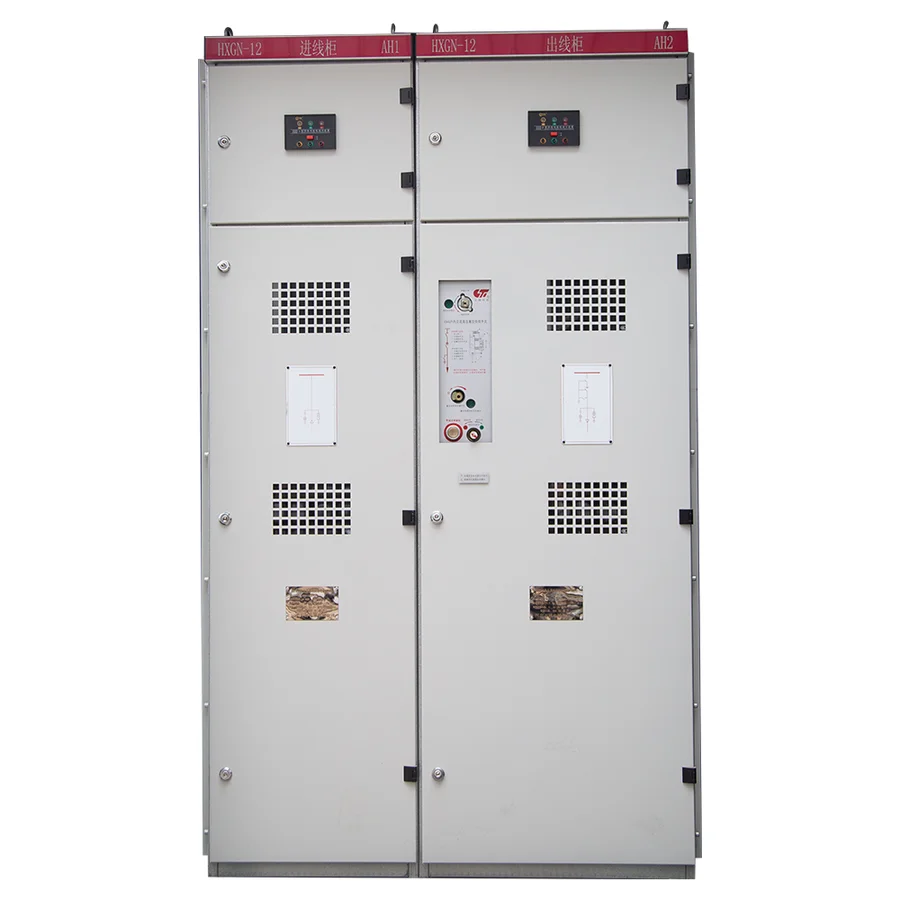
Where the site is outdoors and you would rather avoid civil works, the prefabricated switching station is the other route. The XGW-12 Box-Type Switching Station packages ring main units into a factory-built housing, and works as an incoming and distribution node for a small site. What it replaces is the decision to build a switch room — not the decision about which panel type to use.
A simple test: if the civil works take longer than the equipment lead time, the packaged option earns its price. If the building already exists and only the floor area is tight, indoor compact panels usually win.
A selection checklist that ties back to acceptance
Only after the format is settled do the ratings matter. A compact substation specification normally turns on rated voltage and insulation level, main busbar current, short-circuit withstand, degree of protection and internal arc classification. You do not need to memorise numbers here; you need to know who confirms each one.
- Short-circuit values come from an upstream system study. Do not let a supplier fill them in “from experience”.
- Degree of protection follows the installation environment; an outdoor enclosure and an indoor panel are not held to the same level.
- Internal arc classification drives pressure relief design. It is a structural matter and cannot be retrofitted as an accessory.
- Control supply, anti-condensation heaters and remote signalling should all appear on the order drawing the first time round.
Standards deserve ten extra minutes. For MV switchgear, IEC 62271-1 covers general requirements for switching and controlgear, and IEC 62271-200 is the type-test basis for metal-enclosed and metal-clad assemblies. Projects in China commonly work to GB/T 11022 and GB/T 3906 instead. The two families broadly correspond in test content, but the edition year must be stated explicitly.
When you review a type-test report, check first whether the standard edition cited is the current one. Standards get revised; reports do not update themselves. A report citing a superseded edition does not prove the product is faulty, but it does not demonstrate compliance with current requirements either. The check costs little and prevents a lot of argument later.
Failure patterns that keep showing up in the field
The price of compactness tends to surface a year or two after energisation. In conversations with engineers, the same few issues recur:
- Condensation. A small enclosure with a wide day-night temperature swing will bead water on terminal blocks and insulation surfaces if the heaters are undersized or not interlocked.
- Vents sealed afterwards. To keep dust or animals out, someone blocks the louvres, and internal temperature rises above limits the following summer.
- Insufficient cable bending radius. Space under the enclosure is calculated too tightly, the termination is stressed, and partial discharge appears after long service.
- No room to expand. Electrical headroom was reserved at order stage, but no physical space for busbars or an additional panel was.
None of these are equipment defects. They are operating conditions that never made it into the technical specification. The safer habit is to list ambient temperature range, humidity, altitude and pollution severity line by line in the technical agreement, and let the manufacturer configure heating, ventilation and creepage distance against them. Pollution severity is classified by established practice, but the actual level still has to be confirmed against the site environment.
One straight answer for buyers
There is no best compact substation model, only one that fits the plot. The same electrical ratings inside an outdoor packaged enclosure and inside an existing switch room can differ substantially in price and delivery.
Three things are worth holding firm on in negotiation: ask for third-party type-test reports and verify the standard editions cited; ask for outline drawings showing the minimum clearances needed for door opening, lifting and maintenance; and get auxiliary circuits and expansion provisions onto the order drawing. Do those three and most of what you avoid later is site argument.